
If you're a parent of a child with cerebral palsy, you've probably seen yoga recommended with great confidence — sometimes more confidence than the science supports. This post goes through the main studies one by one, in plain language, so you can see what was actually tested and what was actually found.
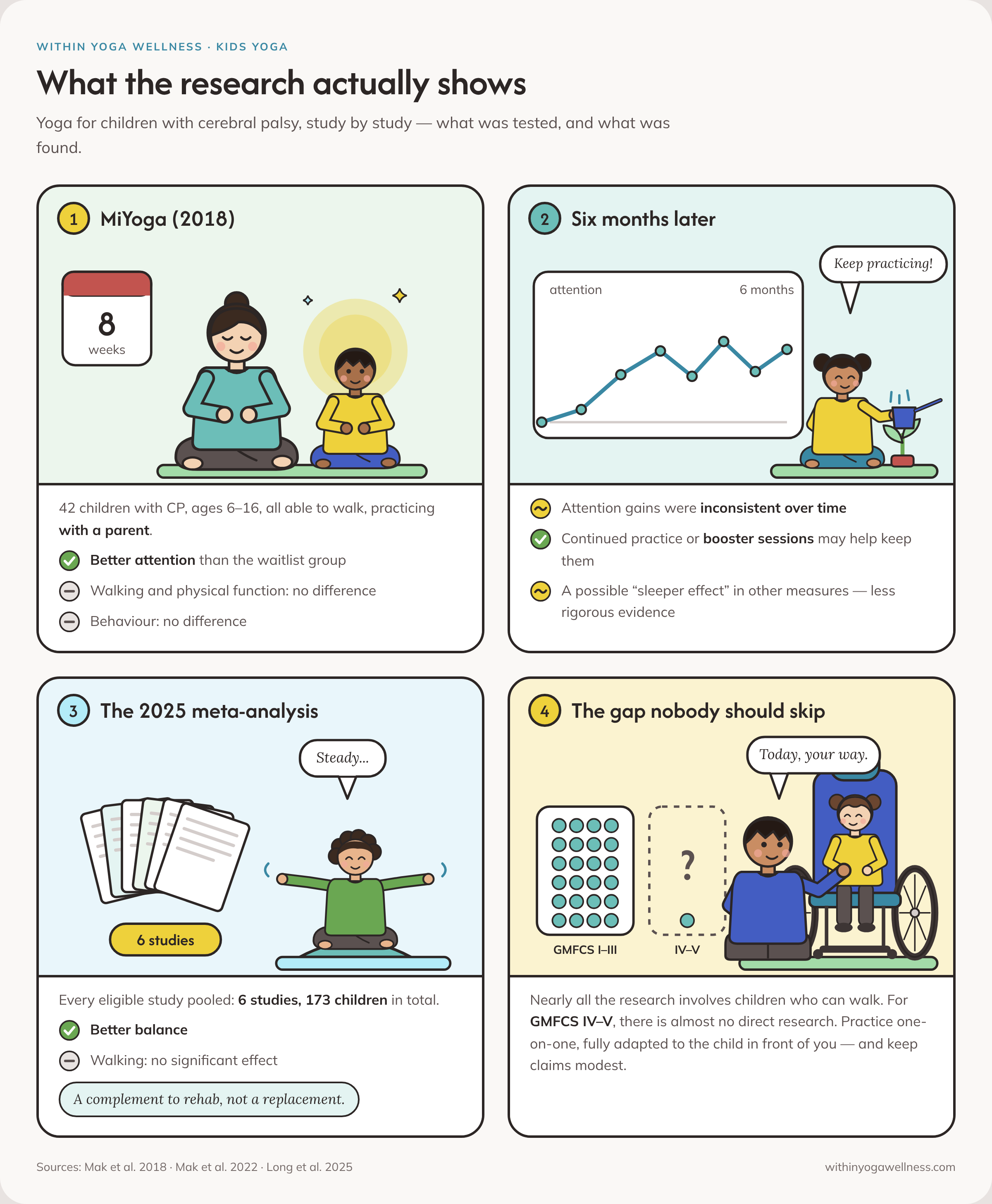
The best-known study: MiYoga (2018). In the strongest trial so far, 42 children with CP aged 6–16 (all able to walk, GMFCS levels I–III) took part with a parent in an 8-week mindfulness-based yoga program. Compared with a waitlist group, the children showed measurably better attention — less inattentiveness and better sustained attention. That's a real, meaningful finding. But the same study found no significant difference in physical function or behaviour between the groups. Yoga did not make these children walk better, and it wasn't shown to change behaviour.
What happened six months later? A follow-up study found the picture mixed: the attention gains were inconsistent over time, which led the researchers to suggest that continued practice — or booster sessions — may be needed to maintain them. Some other measures (executive function, physical function, parents' wellbeing) looked better at six months than before the program, a possible "sleeper effect," though that part of the study was less rigorous.
The newest overview: a 2025 meta-analysis. Pooling every eligible study of mind-body exercise (yoga and similar practices) in children with CP sounds comprehensive — until you see the numbers: 6 studies and 173 children in total. Across those studies, mind-body exercise improved balance, but had no significant effect on walking. The authors describe it as a safe and convenient complement to routine rehabilitation — a complement, not a replacement.
The gap nobody should skip over. Nearly all of this research involves children who can walk. For children with more involved CP — GMFCS levels IV–V, including children who don't walk and need head and trunk support — there is almost no direct research at all. That doesn't mean adapted yoga has nothing to offer these children; it means nobody can honestly quote studies to promise results. For these children, practice should be one-on-one, fully adapted, and guided by what the child in front of you can do today — with claims kept modest.
A few practical practices families can try. The strongest programs in the research — including MiYoga — were done by parents and children together. That pairing matters: children co-regulate with the adult beside them, borrowing the adult's calm before they can find their own. These simple practices follow that idea. Keep every movement gentle and pain-free, adapt freely to your child's abilities and equipment, and check with your child's PT or OT before adding anything new.
Breathe together first. Before asking your child to calm down, slow your own breathing — longer exhales than inhales, for about a minute. Then breathe together: "smell the flower, blow out the candle" works well for young children. Your steady rhythm is the lesson.
Mirror me. Sit face to face and copy each other's slow movements — raising an arm, tilting the head, opening and closing hands. Take turns leading. It's simple, playful, and quietly trains attention and connection.
Heavy work for a settled body. Pushing against a wall, carrying cushions, or a firm "sandwich" squeeze between two pillows (only if your child enjoys it) gives the body strong organizing input that many children find calming before quieter activities.
Gentle movement, side by side. For children who don't walk, including those in supportive seating: slow, supported range-of-motion movements, hand-over-hand arm movements, and breathing together in side-lying — always within the range your child's therapists have shown you, and stopping at any sign of discomfort. The goal here is comfort and closeness, not stretching targets.
One-minute mindful moments. Borrow MiYoga's everyday mindfulness: one minute of listening together (what sounds can we hear?), mindful first bites at a meal, or noticing the feel of water in the bath. Short, woven into routines you already have, and ended while it's still enjoyable.
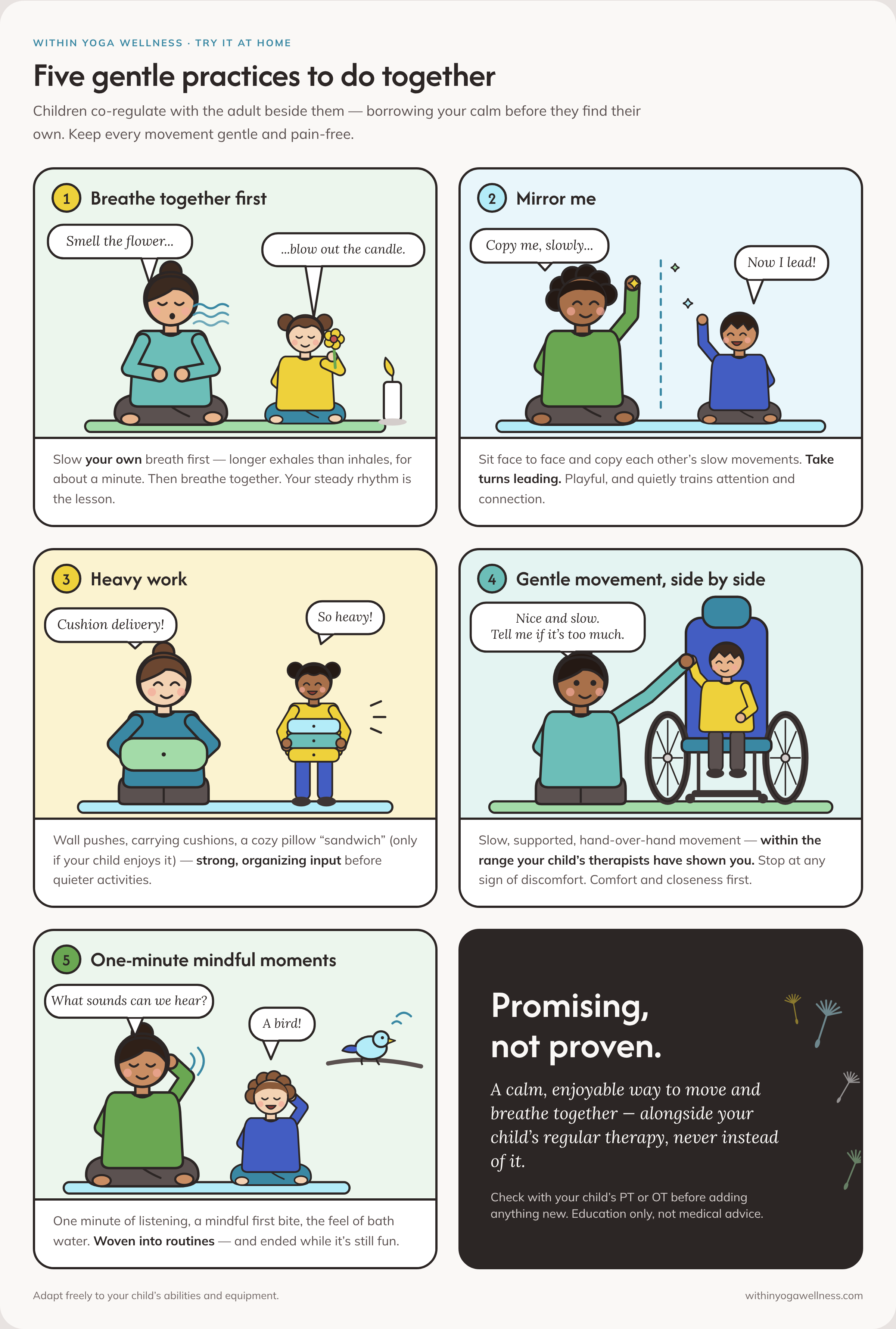
The bottom line. Yoga for children with CP is promising, not proven. The most credible benefits so far are attention and balance, in small studies, mostly in ambulatory children. Done carefully and individually, it may also give a child something studies rarely measure: a calm, enjoyable way to move and breathe, together with a parent, at their own pace. But it belongs alongside a child's regular therapy — never instead of it.
This article is for education only and is not medical advice. Please consult your child's care team about any new activity.
Sources
Mak C, et al. Effect of mindfulness yoga programme MiYoga on attention, behaviour, and physical outcomes in cerebral palsy: a randomized controlled trial. Dev Med Child Neurol. 2018;60:922–932. PubMed: https://pubmed.ncbi.nlm.nih.gov/29869333/ · DOI: https://doi.org/10.1111/dmcn.13923
Mak C, et al. Six-month follow-up of a mindfulness yoga program, MiYoga, on attention, executive function, behaviour and physical outcomes in cerebral palsy. Disabil Rehabil. 2022. PubMed: https://pubmed.ncbi.nlm.nih.gov/32589851/ · DOI: https://doi.org/10.1080/09638288.2020.1783582
Long Y, et al. Effects of mind-body exercise in children with cerebral palsy — a systematic review and meta-analysis. Complement Ther Clin Pract. 2025;58:101930. PubMed: https://pubmed.ncbi.nlm.nih.gov/39536700/ · DOI: https://doi.org/10.1016/j.ctcp.2024.101930
